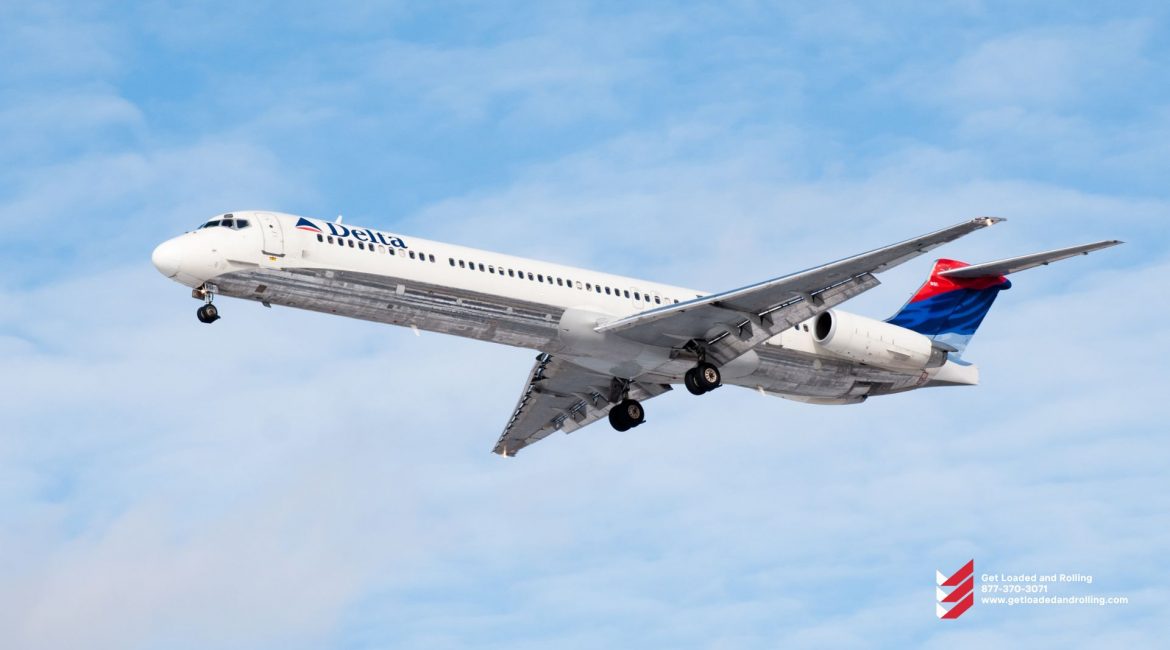
During the first quarter, Delta Air Lines’ cargo business profited from supply chain problems that drove goods to the congested air market. According to a prominent executive, the new logistical congestion in Shanghai, where officials are enforcing a citywide COVID shutdown, could spur even greater growth.
Reduced industry capacity produced a large increase in cargo yield, resulting in $289 million in cargo revenue for the quarter ended March 31, up 51% from the previous year, the business stated Wednesday. In March, it generated a record amount of freight income.
Delta (NYSE: DAL) will take a short-term hit from the halt in economic activity in the greater Shanghai region, but could see increased revenue as businesses look to expedite backlogged shipments and leapfrog delays at Chinese ports, including Ningbo, President Glen Hauenstein said during an earnings call.
Imports and exports are stacking up in major Chinese trading hubs because Chinese officials have sealed off Shanghai in order to eradicate the omicron strain, and the infection wave is spreading. The measures are substantially impeding activity not only at the world’s largest container port but also at Shanghai’s main cargo airport and other airports along the central coast.
Despite the fact that Shanghai Pudong Airport is officially open, due to street restrictions, few trucks can access the cargo terminals to deliver or recover commodities. There are also labor shortages for loading and unloading freight, and many facilities where cargo originates are closed.
Most international passenger and freight flights into and out of Shanghai Pudong airport have been canceled as a result. Delta Air Lines this week imposed a freight restriction in Shanghai that will run until at least April 18.
“In the freight sector, China has been a really strong market for us.” “We’re essentially not flying to China right now until Shanghai reopens, so that’ll weigh on cargo income as we move forward,” Hauenstein explained. However, once the COVID problem is over, the airline might more than makeup for lost business as shippers scramble to clear backlogs.
“As that reopens, you can see that pent-up demand for commodities that need to be sent out of China and perhaps give us another leg up,” he added. “We may see even stronger demand as a result of that.”
Many enterprises have shifted cargo to air in the last year due to severe ocean shipping congestion, putting additional strain on a system that has 10% less capacity due to passenger flight reductions and geopolitical events.
Delta Cargo’s earnings were also $74 million higher than last year when it still provided dedicated cargo service with six aircraft that were not needed for passenger service due to the pandemic travel dearth. The achievement is also noteworthy because it was just $15 million less than the $304 million in cargo sales during the fourth quarter of 2021, which is the biggest shipping season of the year.
Delta Cargo earned $1 billion in sales in 2021, its biggest year to date. Officials at the company have stated that they intend to invest more in technology, partnerships, sales, and operations in order to capitalize on the strong market and significantly expand the cargo business by the mid-decade mark.
In the first quarter, cargo accounted for 11% of Delta Air Lines’ total operating revenue of $9.3 billion. Although cargo’s top-line share has fallen from the depths of the COVID travel abyss, it is still significantly higher than the low-single-digit average it represented prior to the pandemic.
Overcoming omicron and generating a profit
Despite a spike in omicron cases throughout the winter, Delta’s overall first-quarter performance was better than projected. Delta reported a first-quarter loss of $940 million and an adjusted operating loss of $793 million, or $1.23 per share. The company outperformed the Wall Street consensus by 4 cents per share and $360 million in revenue.

Delta Air Lines’ recovery from the COVID issue was halted by the omicron variation after the business eked out a pretax profit for the second half of 2021, but with travel demand fast-rising, officials are projecting an operating profit for the second quarter.
With an operating margin of 10% in March, the airline returned to profitability and forecasted operational profit in the second quarter. Despite seat capacity at 85 percent of pre-pandemic levels and fuel costs 50 percent higher than three years ago, executives estimate profit margins in the 12 percent to 14 percent range, only 4 points lower than in June 2019.
CEO Ed Bastian stated that as COVID fades and governments decrease testing and quarantine procedures, robust travel demand translates into price power. The airline is successfully capturing increased rates, which are more than compensating for the increase in fuel expenses to around $2.79 per gallon. Delta expects to pay $3.20 to $3.35 per gallon for jet fuel by June, which is 20 cents cheaper than the industry average because it has its own refinery near Philadelphia.
Domestic airfares in the United States have increased by 40% since January, according to travel booking service Hopper.
Management cited very good forward bookings and business travel recovering to 70% of usual in March as evidence that the company will turn the turnaround this quarter and have a profitable full year.
