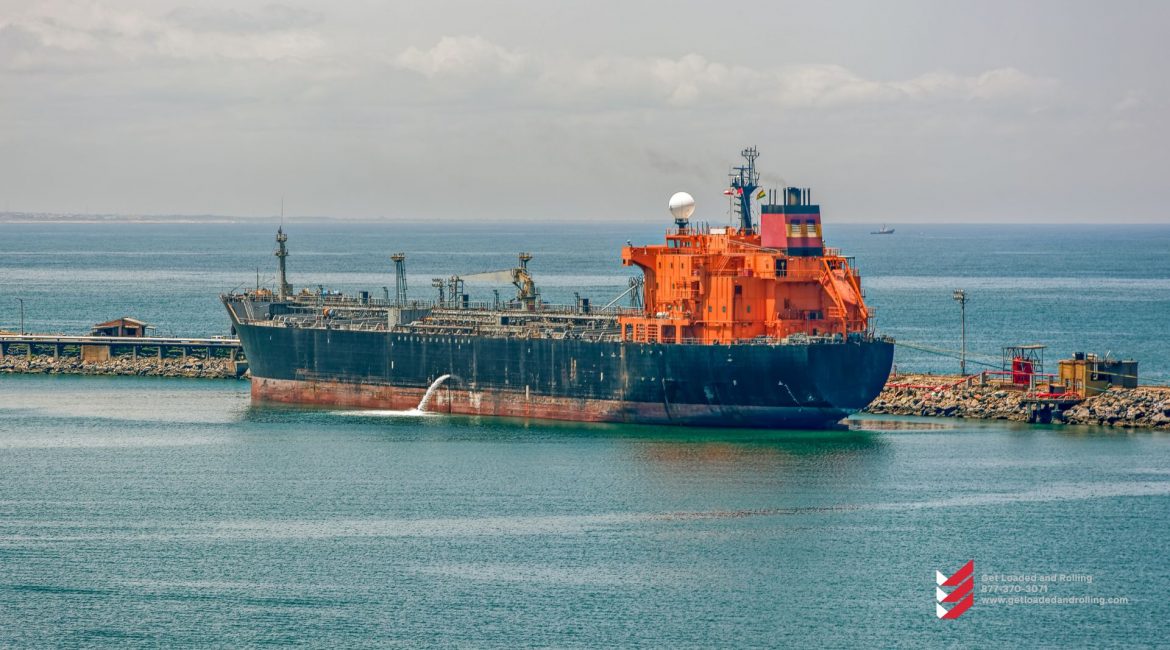
Historically, wars involving oil producers cause tanker rates to skyrocket. A month into the Russia-Ukraine conflict, most crude tanker rates remain pitifully low. Product tanker rates are rising, but not dramatically so.
“The immediate knee-jerk reaction was: Disruptions create market strength,” Evercore ISI analyst Jon Chappell said. “We saw that in 1991 and again in 2003, so the thinking was: Here we have another geopolitical event that will lead to [oil] storage and the substitution effect [buyers finding news sources].”
“But it’s risky to stick with the old model,” Chappell told American Shipper. “Every event is unique.”
Crude tankers are unable to recover.
Crude tanker owners have been losing money since mid-2020 and will continue to do so.
The spot rate for very large crude carriers (VLCCs; tankers carrying 2 million barrels) built-in 2015 or later, according to Clarksons Platou Securities, was just $3,800 per day on Wednesday. This is one-eighth of Clarkson’s estimated breakeven rate for a 5-year-old VLCC, which is $32,000 per day.
VLCC spot rates have fallen by 29 percent since the war began a month ago.
Suezmaxes (capacity: 1 million barrels) built-in 2015 or later are fetching $16,600 per day, more than doubling their average spot rates from a month ago. However, Clarkson’s estimate of a $24,000-per-day breakeven rate for a 5-year-old Suezmax remains far below.
“The only [crude tanker] markets that really ripped were those that were directly impacted: the Baltic, Black Sea, and Med,” Chappell says. Aframaxes (capacity: 750,000 barrels) or smaller tankers serve these short-haul trades.
Long-haul routes plied by larger-sized crude tankers experienced a brief “sentiment-driven spike” in the immediate aftermath of the invasion, according to Chappell, but are now “back to fundamentals.”
“There haven’t been any more Saudi or UAE cargoes to Europe, and there hasn’t been a significant shift in West African crude.” There has been a slight increase in US Gulf exports, but not enough to change the supply-demand balance.”
Chappell cited three reasons why, despite the historically high geopolitical risk, rates for larger tankers remain so low.
First, given the low spot rate levels at the start of the war, ship capacity was “clearly excessive.” Second, “you’re in the spring when there’s typically not that rush to lock in inventories.”
Third, “oil prices just went completely parabolic, and at prices like that in a massively backwardated market, there’s no economic incentive to store oil or try to build inventory going into the summer.” (When a market is backwardated, the current price is higher than the futures price.)
Chappell believes that crude tanker rates have the potential to skyrocket. “But I believe that in order for that to happen, we need to be in this conflict at these current levels or worse by the time we start looking into the winter when Europe becomes a little more desperate to ensure they have inventories,” he said.
“If we’re still fighting in September, the price becomes a lot more irrelevant, and you have to make sure you have supply.”
Product tankers have finally made a profit.
Tankers transporting petroleum products are experiencing a different effect as a result of the war.
The spot rate for LR2 product tankers (capacity: 80,000-119,999 deadweight tons or DWT) built-in 2015 or later was $30,800 per day on Wednesday, according to Clarksons. This is an increase of 344 percent since the beginning of the war, but a decrease of 16 percent week on week.
A 5-year-old LR2’s estimated breakeven rate is $23,000 per day. LR2s have consistently lost money since mid-2020, with the exception of the last month.
Rates for LR1s (capacity: 55,000-79,999 DWT) built-in 2015 or later were $25,600 per day, up 189 percent from a month ago but down 13 percent week on week, with a 5-year-old LR1 breaking even at $18,000 per day. Since mid-2020, LR1s have been consistently in the black for the past month.
“The diesel arb is playing a huge role with products,” Chappell said. “It’s so wide right now that transportation costs can skyrocket while the trader still makes a huge profit on the diesel.” (The arb, or arbitrage, is the difference between the price of a commodity in one location and the price it can be sold for in another.)
“[Diesel] is also more of an all-year market.” The driving season in Europe is approaching, and obviously, truck demand is still extremely high due to consumer demand and supply chain issues. Diesel, in my opinion, has the potential to be more environmentally friendly. It’s clearly represented in some of the long-haul trades [from Singapore, the Middle East, and India to Europe] by LR2s and, to a lesser extent, LR1s.”
Tanker demand is measured in ton-miles, which is the product of volume multiplied by distance. The replacement of Russian products with diesel sourced from Asia by Europe is significantly increasing the distance traveled.
“As long as the arb remains open and Russia is not directly exporting to Europe, that’s a big ton-mile driver to the larger product-tanker sector, and I think that one has more legs until there’s a resolution,” Chappell said.
